
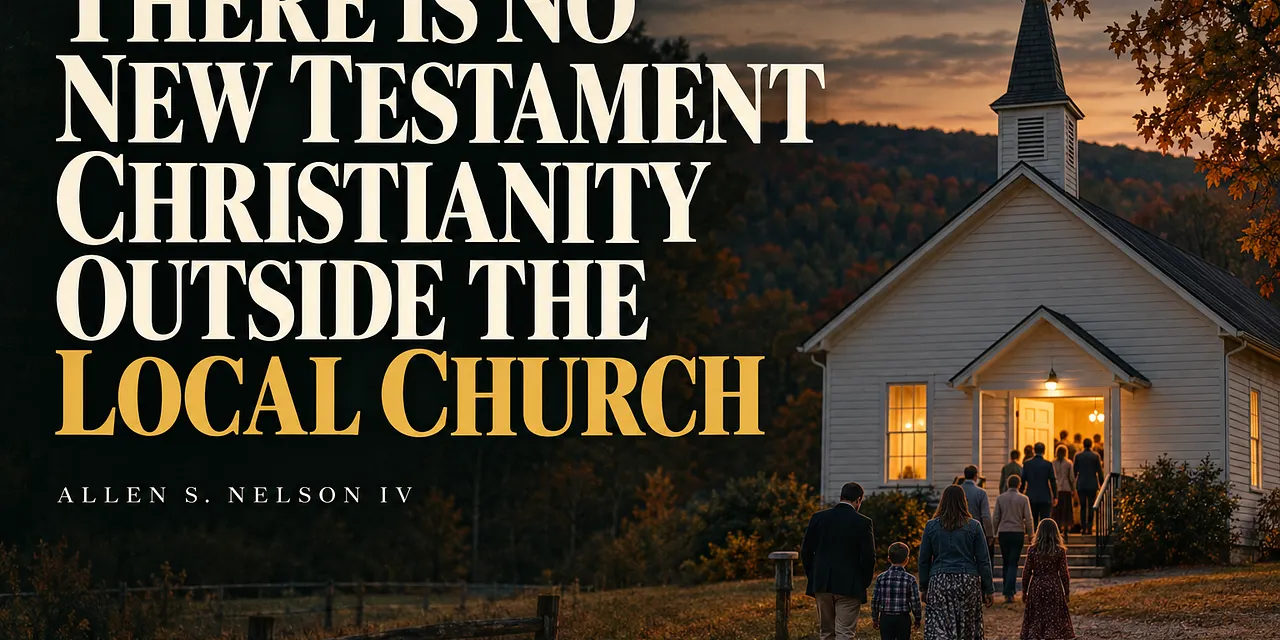
We live in an age where we’ve made Christianity quite individualistic. We take the teaching of the New Testament and we turn it into something how one personally responds, and we forget the centrality of the church.
But…
There are so many passages in the New Testament that you just cannot make sense of without the local church.
Now, I don’t want to minimize at all a personal relationship with Jesus. You need to know Christ and your sins to be forgiven in Christ personally. It’s not your parents’ faith or your grandparents’ or your family members’ or your pastors’. You must believe on Christ. Christ alone for your salvation. You must repent and believe the gospel.
But Jesus says that He came to build His church (Matthew 16:18).
He’s building individual believers into one unified body. This one unified body expresses itself in local, visible congregations all over the earth.
Assuming that you have come to a saving knowledge of Christ, assuming that there’s been a time in your life that you’ve been born again and you’ve repented of your sins and you believe the gospel, here are at least six expectations that the New Testament has of you as a Christian.
1. Submitted to qualified elders
Hebrews 13:17 says:
Obey your leaders and submit to them, for they are keeping watch over your souls, as those who will have to give an account. Let them do this with joy and not with groaning, for that would be of no advantage to you.
How does an individual Christian obey Hebrews 13:17 apart from being committed and under the leadership of qualified and appointed elders in the church?
God has appointed qualified men in the church to watch over the souls of the church.
Pastors are charged before God to keep watch over your souls. Do you understand the weightiness of that? The text says, “as those who will have to give an account.” Your pastors, one day, will stand before God.
One of the duties of the Christian life is to be submitted to qualified elders.
How do you do that if you’re not a member of a church?
2. Formal covenantal membership with the local church
Galatians 6:2:
Bear one another’s burdens, and so fulfill the law of Christ.
How is it possible that Paul expects me to bear the burden of every Christian on the face of the planet? I don’t even know the names of every Christian on the face of the planet.
What is it that Paul means? He’s talking about a local, visible congregation. A local, visible people that you know, that you see.
I’m going to help sister so-and-so with her situation. I’m going to help brother so-and-so with his situation. I’m going to help my brothers and sisters as they fight sin. I’m going to pray for them. I’m going to walk alongside them. I’m going to point them to Christ.
Why? Because I’m in a covenantal relationship with them. I promise to watch over them, and they watch over me.
That’s the way that this church membership works.
Similar in Ephesians 4, when it talks about the body and each part working properly. Inside the local church, as this group is functioning as they’re supposed to and this group is functioning as they’re supposed to, what happens is it’s like a body where your hands and your feet and everything’s working together.
All these things are working together, and you’re growing and you’re healthy. So too in the local church.
3. Gathering weekly with the local church on the Lord’s Day
Hebrews 10:24–25:
And let us consider how to stir up one another to love and good works, not neglecting to meet together, as is the habit of some, but encouraging one another, and all the more as you see the Day drawing near.
The expectation of believers in the New Testament is a regular weekly gathering, at minimum. There is an appointed time for this gathering.
It is the Lord’s Day.
What Christian would you know who would say, “Well, I don’t take the Lord’s Supper. I take every meal as God’s meal”?
They know better than that.
But how many have you heard say, “Well, I don’t have to worry about the Lord’s Day. Every day is God’s day”?
Every day is God’s day. He owns every day. Every day when we wake up, we ought to thank the Lord for the day He has given us.
But there is this special day. There is this one day in seven that God has given us, and this day we call the Lord’s Day (Revelation 1:10)
A lot of us interact with people who say, “Oh, yeah, I’m a Christian.” They’re not submitted to qualified elders.
“Oh, yeah, I’m a Christian.” They’re not in formal covenantal membership with the local church.
“Oh, yeah, I’m a Christian.” They don’t gather weekly with the local church on the Lord’s Day.
Who’s wrong? Are they wrong? Or is the Bible wrong?
I assure you, it’s not the Scriptures.
4. Watching over and being watched over by fellow church members
Hebrews 3:12–13:
Take care, brothers, lest there be in any of you an evil, unbelieving heart, leading you to fall away from the living God. But exhort one another every day, as long as it is called “today,” that none of you may be hardened by the deceitfulness of sin.
If you’re not part of a healthy church, how is it that you are obeying what is instructed to us in Hebrews 3?
We’ve got to know each other. We are commanded by God to be involved in one another’s life.
This fight that we fight, the fight of faith, and the race that we run—you don’t do it alone!
“Well, I’ve got the Holy Spirit.”
Amen. You’ve got the Holy Spirit. He’s who we need. Praise God.
But the Holy Spirit has put brothers and sisters in your life so that you will keep fighting the fight of faith and you won’t be discouraged and you won’t back down.
Sometimes you need an encouraging word, and sometimes you need an accountable word, and sometimes you need someone to kick you in the pants and get you going.
Sometimes you need someone to just come up beside you and say, “Don’t quit, don’t quit, don’t quit. Keep running, keep running.”
But you also have a responsibility to be humble enough to be watched over.
Someone offers you a word of encouragement, or a rebuke if necessary. Receive that. Be willing to at least examine the Scriptures and consider, because God has given you brothers and sisters, not only for you to watch over, but them to watch over you.
5. Faithfully giving financially to the mission of the local church
1 Corinthians 16:2:
On the first day of every week, each of you is to put something aside and store it up, as he may prosper, so that there will be no collecting when I come.
You can’t say that the New Testament does not expect believers to give faithfully to the church financially.
This doesn’t mean that if you don’t give a certain dollar amount, you’re not saved.
Some people are very well blessed. Other people struggle financially. But the point is that the way that the church funds her needs, the needs of the body, the needs of the mission of Christ, the needs of the furtherance of the gospel to the ends of the earth, is through our giving.
How can you say that you’re faithfully following the teachings of Christ, but you’re not connected to the church?
6. Being hospitable to one another
1 Peter 4:9:
Show hospitality to one another without grumbling.
There are people who go to church together their whole lives and have never been in another home together. I would argue that this is a misunderstanding of the New Testament.
There’s not a blanket law here that we can say, “You have to have X number of people in your home, X number of days.” We can easily make these sort of things silly and legalistic.
But all of us must have a hospitable disposition. All of us must have the desire to serve one another and, as we are able, to open up our homes to one another.
“My house isn’t clean. The kids are not behaving.”
It is hard. That’s why Peter says, “Show hospitality,” with the expectation, “without grumbling.” Because he knows it’s hard.
But we’ve been changed by grace.
Some of you, maybe you’re not able. There’s some sort of circumstance why it’s hard to get people in your home. But how can you be hospitable with your time? How can you be hospitable with your resources?
“Here’s my tools. Here’s my expertise. Here’s a way that I can be hospitable in other ways.”
As each has received a gift, use it to serve one another as good stewards of God’s varied grace.
And remember, it’s for one another. This, in the context of 1 Peter, is dealing with fellows members of the local church (1 Peter 1:1).
What about you?
As important as individual prayer and Bible reading are—that should be a daily reality in your life—as crucial as family worship is—that ought to be a regular part of our lives—you cannot have New Testament Christianity apart from these things mentioned above.
New Testament Christianity, by definition, is defined by what?
The New Testament.
“What about people who are deployed? What about people who are in the nursing home? What about people that are homebound?”
Do I acknowledge that there can be legitimate exceptions at times? Of course. But exceptions are what? Exceptions.
We can weigh those out according to the Bible, but exceptions are not the norm.
Brothers and sisters, what faithful churches are doing may seem crazy to others. It may seem countercultural. But what true churches are doing is literally just trying to take God’s book and apply it
There is no New Testament Christianity outside the local church.
If you are a Christian and you’re a member of a faithful church, praise God. Press on. Keep doing it.
If you’re not a Christian, repent and believe the gospel, and find a bible believing church, join it, and give your life to those people
This is the life that God has called us to live, and there’s nothing more beautiful.