What Acts 10 teaches us about the Old Covenant, the New Covenant, and the fulfillment of God’s promises in Jesus Christ.
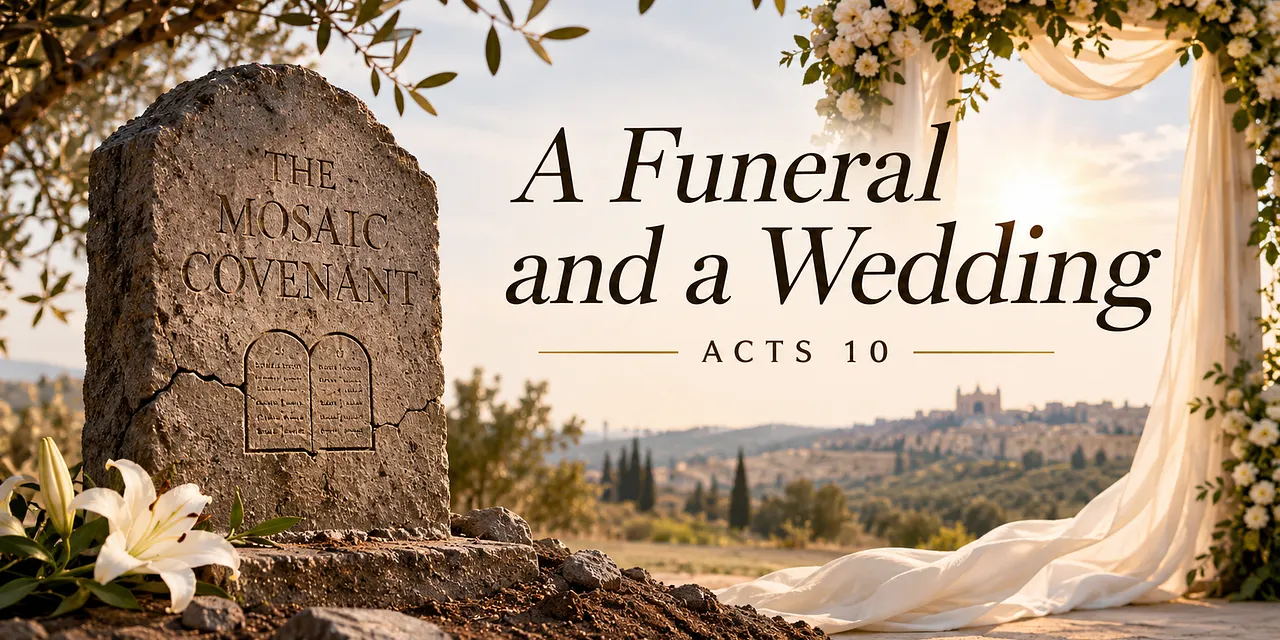
In Acts chapter 10, we witness a funeral and a wedding. Just bear with me…
It’s quite the narrative. Cornelius is a Gentile in Caesarea. Peter is lodging with Simon the Tanner in Joppa. Remember that Joppa was the place that Jonah ran to in order to run away from the Gentiles. But this is the same launching point in the New Testament that God is going to use to launch the mission to the Gentiles.
A vision is given to Cornelius the Gentile. A vision is given to Peter the Jew. Cornelius sends for Peter under the direction of an angel. Peter travels to Caesarea according to the direction of the Holy Spirit. He preaches Christ. And what happens?
While Peter was still saying these things, the Holy Spirit fell on all who heard the Word. The believers from among the circumcised who had come with Peter were amazed because the gift of the Holy Spirit was poured out even on the Gentiles (Acts 10:44–45).
That’s good news for you and me.
Up to this point in Acts, everyone who received the Spirit had Jewish ties. In Acts 2, you have the Jews. Then the Hellenists, Greek-speaking Jews. Then the Samaritans, who practiced circumcision and could trace their lineage back to Israel.
But now you have clearly a Gentile man.
Luke is careful to show us that Cornelius is not a Jewish proselyte. He is a God-fearer. He has come into contact with the God of the Bible through the Jews in Caesarea, but he has not converted to Judaism.
And by the end of the chapter, Cornelius comes to a saving knowledge of Christ and enters the promised New Covenant without becoming Jewish first.
He doesn’t go through another mediator in order to get to Christ. All of that is set aside. Straight to Jesus.
What the Old Covenant Had
To understand what’s happening, we need to set Acts 10 against the background of the Old Covenant. By Old Covenant, I am referring to the Mosaic Covenant, the covenant God made through Moses.
The Mosaic Covenant, contrary to what you may hear today, was a temporary arrangement. It was a means to an end.
God gave Israel the moral law on tablets of stone, the Ten Commandments. He also gave them specific civil and ceremonial laws to show them their need for the coming Messiah and to set them apart from the nations, preserving the line through which the Messiah would come.
There are three things I want to remind you the Old Covenant had.
1. A Wall of Separation
The Mosaic Covenant separated physical Israel from everyone else.
We see this at least twice in Acts 10.
In verse 14, Peter says, “By no means, Lord, for I’ve never eaten anything that is common or unclean.”
And in verse 28, Peter says, “You yourselves know how unlawful it is for a Jew to associate with or to visit anyone of another nation…”
Peter is wrestling with this wall of separation. The wall of separation was put up to preserve the line of the Messiah.
It included dietary laws. What you could eat and what you could not eat. What you could wear and what you couldn’t wear. How to grow your crops. These laws flowed out of the Mosaic Covenant and dealt with being clean and unclean.
But understand the point of all this. It’s like a fence. God was putting a fence around the line of the Promised One so that He would come as He had been promised.
And that makes us back up just a bit. Our confession, the Second London Baptist Confession of Faith, says in chapter 7, paragraphs 2 and 3, that
God was pleased to make a covenant of grace, freely offering sinners life and salvation through Jesus Christ, requiring faith in Him, and promising His Holy Spirit to make His people willing and able to believe. This covenant was revealed first to Adam in the promise of salvation through the seed of the woman. After that, it was revealed step by step until its full revelation was completed in the New Testament.
Let’s lay out the storyline.
Adam disobeyed God. In that disobedience, he plunged all humanity that would spring from him by ordinary generation into a state of sin and misery.
But God, in Genesis 3:15, made a promise. There would be a seed from the woman who would undo this wretched rebellion that Adam had done. He would crush the serpent’s head.
And everyone who was saved in the Old Testament was saved by looking forward to that promise. They were saved by faith in Christ.
How could they be saved by faith in Christ? He hadn’t even come yet! He was promised to come. They were to look forward to Christ, to believe on His name, and trust Him by grace alone through faith alone.
Now, a question early in the Old Testament would be this: Where is the seed going to come from?
In Genesis 12:3, God says to Abram, “In you all the families of the earth shall be blessed.” The promised seed would come from the line of Abraham and bless the nations.
Then, 430 years after Abraham, you get Moses and the Mosaic Covenant. Paul says in Galatians 3:17 that “the law, which came 430 years afterward, does not annul a covenant previously ratified by God so as to make the promise void.”
The Mosaic Covenant was not creating a different way of salvation. Rather, it was preserving the line of Abraham so that the promise made to Abraham, and the promise made to Adam and Eve, would be fulfilled.1
This is why you have a wall of separation between Israel and everyone else.
2. A Reminder of Sin
You cannot imagine the bloody mess that the Old Covenant was.
Death. Blood. Sacrifice.
Constantly in these sacrifices, there was a reminder of sins.
The Old Covenant in and of itself was insufficient, not because of God, but because of the sin of man. Mankind was already guilty in Adam, and then they sinned willfully by their own volition. And it is impossible for the blood of bulls and goats to take away sins.
In all this blood and sacrifice, there was a constant reminder that your sins were not forgiven by these means. They hadn’t been put away.
You needed something else tomorrow. You needed something else next year.
There was nothing in the blood of these animals to save you.
3. Types and Shadows
Hebrews 8:4–5 tells us that those who “offered gifts according to the law served a copy and shadow of heavenly things.”
The Mosaic Covenant was not only a fence to guard the promised line. Contained by design within the Mosaic Covenant were all these arrows, these big, giant arrows pointing to Christ.
They were pointing to the coming ratification of the covenant of grace.
They were pointing to the New Covenant in Christ.
The Funeral of the Mosaic Covenant
Hebrews 8:13 says:
“In speaking of a new covenant, he makes the first one obsolete. And what is becoming obsolete and growing old is ready to vanish away.”
This is the funeral.
The death of the Mosaic Covenant. In Acts 10:15, the voice comes to Peter a second time: “What God has made clean, do not call common.”
What is going on here? All these dietary restrictions, this wall of separation, have tumbled down because the Mosaic Covenant has been abrogated in Christ.
It’s actually a very long funeral.
In Mark 11, Jesus curses the fig tree. That’s around AD 30. The fig tree is cursed, symbolizing judgment upon fruitless national Israel.
Then what happens when Jesus dies?
The veil in the temple is torn from top to bottom, showing that Jesus has not come to reestablish the Mosaic Covenant or bring it back at the end of time.
He came to end it, to abrogate it in His fulfillment of it.
That’s all around AD 30. But you don’t have the destruction of the temple that Jesus promised until AD 70.
You have forty years between these two events. That’s a long funeral!
Between those two events, we have Acts chapter 10, perhaps between AD 35-38.
Acts 10 is part of this long funeral of the Mosaic Covenant, which ended in AD 30, but whose lifeless body hung around, as it were, until the public, conclusive removal in AD 70.
Why am I telling you all this?
Because you need to see, at least in part, through Peter’s eyes. He was born under the Mosaic Covenant. He is a physical descendant of Abraham. But now Christ has come.
Imagine being in his shoes, or his bare feet, as it were.
He’s seeing in real time the promises of Genesis 12 and Jeremiah 31 and all the prophets and poetry and all the Old Testament pointing forward to Christ.
In Acts 10:43, Peter says, “To him all the prophets bear witness that everyone who believes in him receives forgiveness of sins through his name.”
In real time, we’re witnessing an aha moment in Peter.
The old is out.
The temporary is gone. National Israel and the Mosaic Covenant has served its purpose.2
It’s not coming back.
It has been abrogated, finished, fulfilled by Christ.
The Wedding
But Acts 10 is not merely about a funeral. It is also about a wedding.
The Old Covenant had a wall of separation. But in the New Covenant, there is one people.
The Old Covenant was a bloody mess. But the New Covenant has a final word on sin, not by the blood of bulls and goats, but by the blood of the Lamb.
And the Old Covenant had types and shadows. But the New Covenant brings fulfillment.
Jesus Christ has fulfilled the Mosaic Covenant in every way.
There are people today who say that as Christians, we need to be faithful to the Mosaic feasts.
That’s foolish.
There are people today who would say one day in the millennial reign, God’s people will return to Mosaic sacrifices.
Also silly.
Both of these are like telling me that, though I’ve been married to my wife for twenty years, I need to go back and live like we’re engaged.
No, the engagement’s over, y’all.
We’re married.
The old has passed away. The new has come.
The marriage is much better than the engagement.
And in Acts 10, we see the anticipation of the wedding. Jesus Christ is gathering His bride from among the nations.
The Old Covenant was a temporary arrangement. It was a means to an end. But now Christ has come. The promises have their fulfillment in Him. The wall of separation has tumbled down. The blood of bulls and goats could never take away sins, but Jesus Christ has become the final word on sin.
And God is giving His eternally begotten Son a bride.
The Bridegroom has come, and He now bids the nations come. He is gathering His bride from every tribe and tongue and nation.
Peter is not announcing a new way of salvation for the Gentiles. He is announcing the fulfillment of the salvation God promised in the Old Testament.
Here it is, Cornelius. Here is Christ. Here is the kingdom. Here is the church.
The old chapter closes. God’s grand and gracious redemptive plan unfolds before our eyes. The gospel promised in the Old Testament is being proclaimed to the nations in Acts 10.
Jesus Christ bled for the nations.
And the nations don’t go through Moses to get to Jesus.
The funeral is over. Get to the wedding!
It also dealt with the promises to inherit land which physical Israel failed to live up to, but is fully realized in the church who inherits the land and the entire earth. Matthew 5:5, etc.
This doesn’t mean there is not possibility for ethnic Jews to be saved. They need the gospel! But it does mean that as an “entity”, National Israel has fulfilled its redemptive and eschatological purposes.