The Bible is about Jesus.
The Bible is about God’s love for sinners.
The Bible is about the glory of God.
All that’s true. Amen. Praise God. But I’m going to give you another thought-provoking way to think about the Bible:
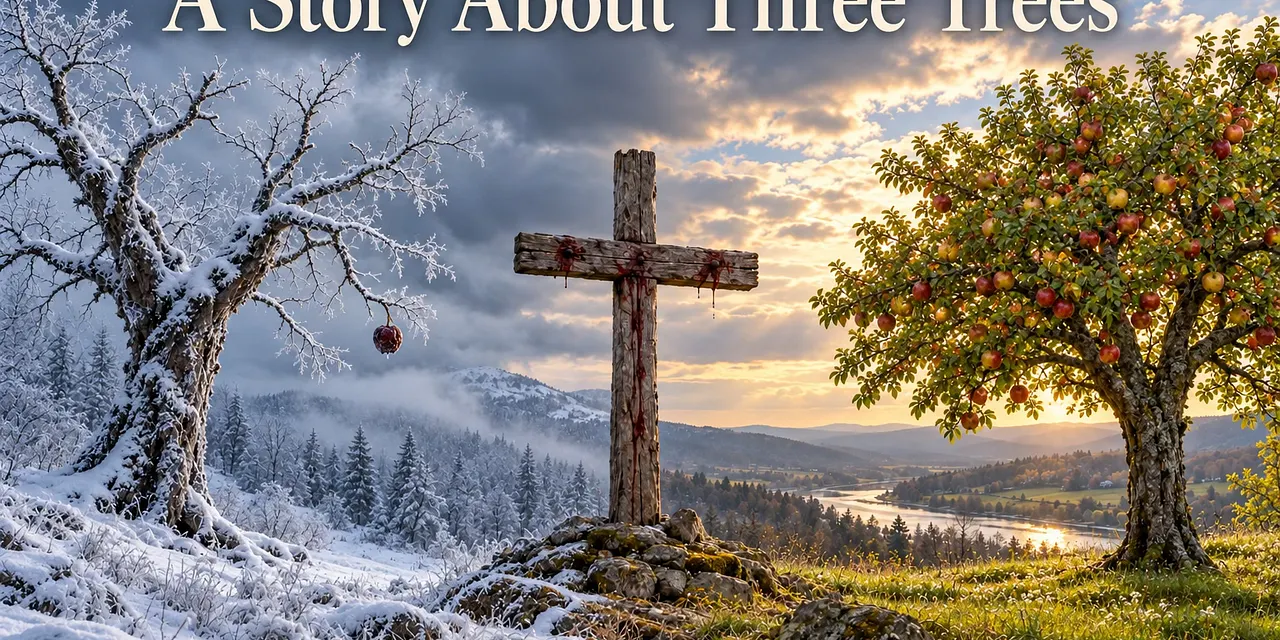
The Bible is a book about three trees.
One tree grew in the Garden of Eden. It is the Tree of the Knowledge of Good and Evil, emblematic of our need for obedience to God’s Law.
Then there’s another tree we also see in the garden, but it’s more helpful for our purposes to consider that this tree appears again at the end of the Book, in Revelation 22. It is the Tree of Life.
You’ve got these two trees, and they’re the bookends of the Bible. At the beginning, the tree that says, obey God and you have life. Don’t eat from this. Trust God. Love Him.
But this tree is eaten from. And mankind is plunged into sin and misery. And the Lord shuts off access to the Tree of Life. But then that tree shows up at the end of the book, and you’re like, “Well, wait a second. How does this happen? They get to eat the tree of life after all?”
And that’s because of the third tree that bridges the gap between trees one and two.
To understand why that third tree is so central to the gospel, we need to understand what happened at the beginning.
A King Under Authority
In the Garden of Eden there lived a king. A king brought there by God. His name is Adam.
God gave Adam, the first man, a mission. That mission is to further the kingdom over all the earth, and God is going to reign through the man that He appointed as federal head of the human race. The key to all of this is that Adam would serve as a king under authority. He was to live happily, joyfully, gladly under God’s kingship over him. And he was to love the Lord his God with all his heart, mind, soul, and strength.
This relationship between God and Adam is expressed through a covenant. This is the Covenant of Works. Our Baptist Catechism use the interchangeable “covenant of life”:
When God had created man, He entered into a covenant of life with him upon condition of perfect obedience, forbidding him to eat of the tree of the knowledge of good and evil upon pain of death.
In the garden, Adam represented all mankind. His meeting or failing the conditions of this covenant would affect not only him, but all his posterity.
Adam owed obedience to God by virtue of his being a creature. God owed Adam nothing in terms of a reward for obedience. God did not have to give him a reward. But He condescended to Adam and promised life.
You disobey, you die. You obey, you live.
Adam had everything before him to glorify God and enjoy Him forever. He would be given a wife in order to be fruitful and multiply and fill the earth and subdue it and enjoy the mutual blessing of community, to work the garden, to keep it.
He was to build and to love and to invent, and to labor, and to cultivate, and to grow, and all these beautiful things he was to do as vice-regent of God. This is God’s good world. And Adam was charged with doing all of these things, and leading his wife in the same.
Yet the man and woman were to do all of that under the authority of God. In happy obedience to God. Loving God with heart, soul, mind, and strength. Trusting God. Obeying God.
So this prohibition of not eating of the tree of the knowledge of good and evil is not just an arbitrary command. It is a specific (positive) command flowing out of this much bigger covenantal framework. Obedience to this command is an outward demonstration that Adam loves the Lord his God with all his heart, soul, mind, and strength, and loves his neighbor as himself, which is a summation of the moral law.
These are the terms of the covenant of works: personal, total, exact, and perpetual obedience.
And what happened? Adam broke it. Our first parents did not continue in their holy and happy condition.
“Let’s Just Fix It”
Adam and Eve thought some fig leaves might fix their nakedness. It is very natural for mankind in our sinful state to say, “Well, we broke something. So let’s just fix it.”
Your little three-year-old drops your favorite coffee mug—not that I’m speaking from experience—and you just hear it shatter into oblivion .
“What was that?”
“Nothing.”
Or maybe your kids get a little older. Have they ever tried to glue something back together that they broke and then kind of set it like you’d never notice? “Oh yeah, I guess it’s always looked like that.”
That’s what we’re doing when we try to put this back together. “We need to work? All right, let’s work.” Let’s just obey God and make it better!
We see this in every works-based religion out there. It is actually the fundamental thread that holds all false religions together. It’s all works. And it’s all damning to mankind.
From a pagan savage to a sophisticated Roman Catholic. Mankind invents ways to “obey” God so that we can rectify what went wrong in the Garden.
There’s something in us that knows there’s something wrong with the world. So we’re like, “Okay, something’s broken about us, and I’ve got to figure out a way to put it back together. So I’ve got to work. I’ve got to do these things.”
That’ll damn your soul. The law, broken by Adam, cannot be mended by you.
Some people want to think about God like the college professor. Everybody made an F on the test. So the professor says, “Okay, we’ll take a 58, and now we’ll make that a 98. And now everybody passes.”
That’s not God. God cannot lower His standard.
But here’s the beauty of it:
God doesn’t lower His standard. He sends His Son to meet that standard in our place.
This is why this is so central to the gospel.
The Works of Someone Else
Jesus Christ, the Son of God, truly God, assumed human nature in the womb of Mary to be born in the likeness of men. He gave to God in His humanity what Adam did not, what you would not: personal, total, exact, and perpetual obedience.
And what happens if you obey the Law? You live.
But Christ dies. Why? To take the penalty of covenant breakers upon Himself.
This is that third tree. Jesus bore our sins in His body on the tree (1 Peter 2:24), bridging the gap between the Tree of Knowledge of Good and Evil and the Tree of Life.
This is the centrality of the cross. Christ suffers for sinners to bear the just demands of the law in their place. He obeys the law. He dies for lawbreakers under the wrath of God. He rises again from the dead.
That’s the gospel.
Indeed, our hope of salvation rests absolutely entirely upon works.
Absolutely it does. The hope of our salvation is 100 percent dependent upon works, because God says that we must obey.
Here’s the problem: your works are foul and odious and not meritorious.
So what are we going to do? Just hope that God sweeps our sins under the rug? Just hope that God says, “Well, you know, I’ll just look past it. You can’t do it”?
Our first parents were barred from access to the Tree of Life, and you think, “Well, maybe God will just change His mind and overlook my sins?”…
No. Works are required, but we must look to the works of Someone else.
It’s Christ. Our salvation depends wholly on the works of Christ. We are saved by grace alone, through faith alone, in Christ alone, because Jesus alone has completed all the work.
You try to drag your works through the door of salvation, and you won’t fit. You will go to hell dragging your works the whole way. But you let go of them, and you run to Jesus, and you have all your hope of salvation in His finished work, you’ll be saved.
Of course, believers in Christ seek to obey our good and gracious King because our hearts have been changed. Because we love Him, and we love His glory, and we love the good of our brothers and sisters. Those who rest in the finished work of Christ seek to follow Him, but never in such a way that we trust our works or our obedience as somehow meritorious in any way.
We work from faith, not for faith. You’re not working in order to get faith or be rewarded with salvation. You’re working from it. Because you’ve been saved.
Those who trust Him follow Him, because He has completed all the work as our only suitable and all-sufficient Savior.
They Get to Eat After All
Peter uses the word “tree” intentionally in 1 Peter 2:24. He doesn’t use “cross.” He uses “tree” because he’s drawing our minds to the fact that cursed is everyone who is hanged on a tree.
Then, at the end of the book, Revelation 22:14 says:
Blessed are those who wash their robes, so that they may have the right to the tree of life and that they may enter the city by the gates.
Through His work on that third tree, and resurrection from the dead, Christ grants sinners access to the Tree of Life after all.
Are you guilty? Are you convicted? Are you weary? Are you sinning? Come to the Lord. He’s done it all. Rest in Him. It’s Christ alone. Trust Him by faith.
The cross is the tree that bridges the gap between the other two trees. At the first, we disobeyed and came under the curse. On the third, Jesus bore that curse and washed us in His blood so that we can eat from the other.